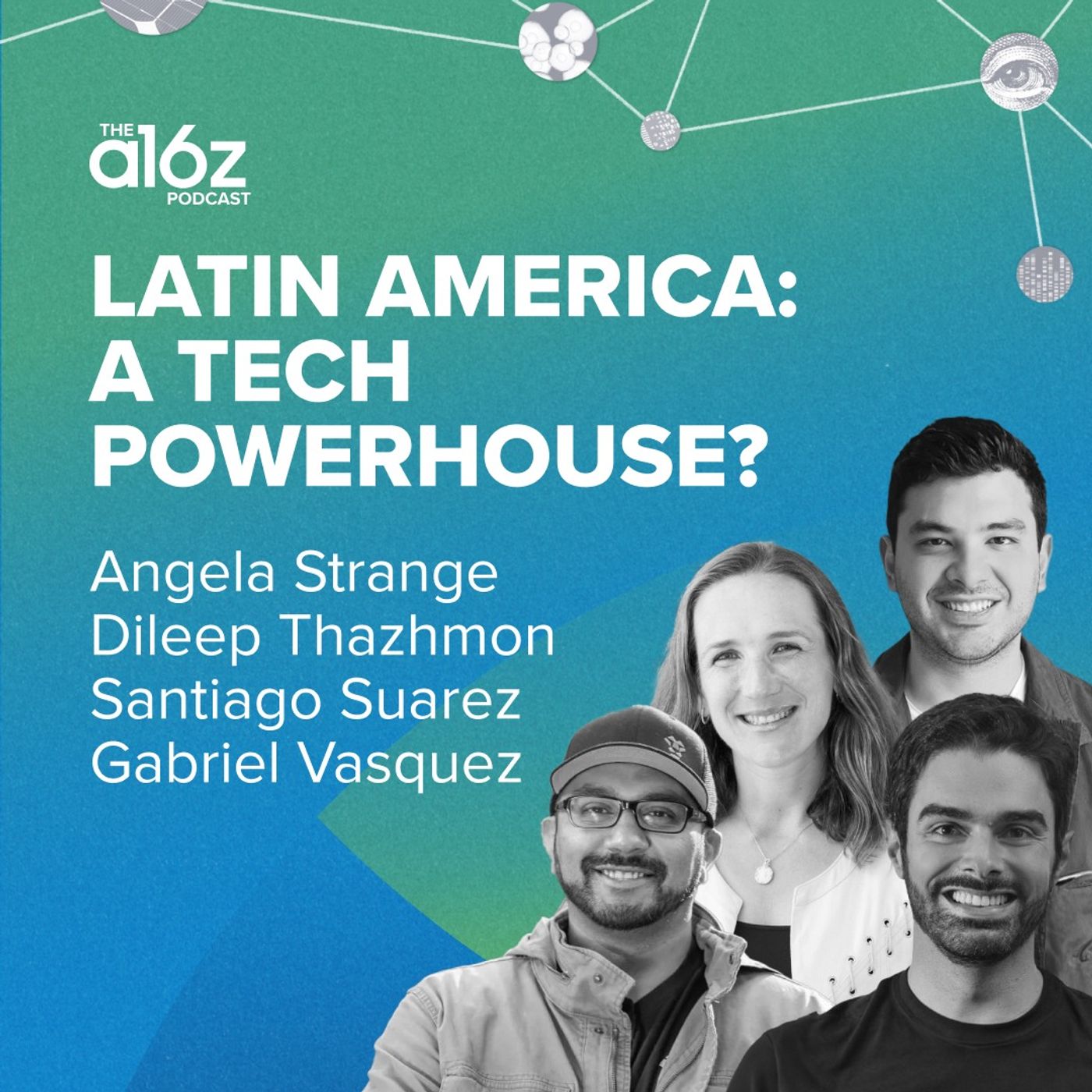

Latin America: A Tech Powerhouse?
24 August 2024 - 33 minsLatin America is emerging as a tech powerhouse, but it's not a one-size-fits-all market.
In this episode, we explore why what works in Argentina won’t necessarily fly in Brazil or Mexico, and how companies are adapting to these unique regional dynamics. Join Dileep Thazhmon, Cofounder and CEO of Jeeves; Santiago Suarez, Cofounder and CEO of Addi; Gabriel Vasquez, a16z investment partner; and Angela Strange, a16z General Partner, as they discuss the future of fintech in LatAm and the unique approach required to succeed in this diverse market.
Whether you're interested in the nuances of product development, the complexities of scaling across diverse markets, or the future of fintech in La...
Series Episodes


OpenAI: When AI Agents Use Computers Faster Than You
AI agents are approaching a point where they can use computers faster than expert humans, turning the user interface itself into a universal way for AI to interact with software. OpenAI’s Ari Weinstein and James Sun argue that computer use is now entering its scaling moment, as better models, faster execution, and stronger safety controls make agents practical for more consumer and enterprise work. Ari and James join a16z’s Seema Amble and Fabrizio Serafini to explain how computer-using agents are already navigating legacy ERPs, reconciling financial data, handling procurement, and operating software without APIs or custom integrations. They also discuss why the harness around the model can matter as much as model intelligence, how enterprises can set deterministic guardrails around agent behavior, and why computer use could simultaneously extend the life of legacy software and accelerate the arrival of new AI-native applications. Looking ahead, they make the case for a more proactive and fluid relationship with computers, where agents work in the background, collaborate with users in real time, and increasingly adapt to us rather than requiring us to learn how to use them.
45 mins
26 October Finished
The New Startup Playbook | Box CEO Aaron Levie
Can a 10-person startup outperform a company with hundreds of employees? Box CEO Aaron Levie argues AI agents are giving small teams a level of leverage that simply wasn't economically possible before, creating a window for startups to outrun incumbents. In this episode of Speedrun Office Hours, Aaron explains why founders are shifting from doing the work themselves to orchestrating agents, and why that puts a new premium on strategy, taste, and knowing exactly what to build. He makes the case that nearly every industry and job function could support specialized AI agents, potentially creating hundreds of new billion-dollar companies. They also discuss why enterprise AI may capture much of the next wave of model improvements, how dramatically cheaper AI labor could unlock demand that doesn't exist today, and one thing Aaron thinks AI won't change: distribution. If you build it, they still won't necessarily come.
34 mins
25 October Finished
What It Takes to Win as a Founder | Ben Horowitz
What does it take to build a company when AI is changing the rules this quickly? Ben Horowitz argues that technology may make companies easier to start, but the hardest parts of entrepreneurship, making decisions under uncertainty, building momentum, and managing your own doubts, aren't going away. Speedrun's Andrew Chen sits down with Ben to discuss why AI feels different from previous technology shifts, whether billion-dollar companies can be built with tiny teams, and why Ben thinks the application itself may eventually become less important as agents work directly against data. They also get into defensibility in AI, what founders should look for in an investor, how venture capital is changing, and why the best entrepreneurs aren't defined by a lack of weaknesses, but by having a strength or insight that's genuinely exceptional.
41 mins
24 October Finished
Amazon CEO Andy Jassy on the $220 Billion AI Buildout
Amazon expects to spend roughly $220 billion in CapEx in 2026, yet CEO Andy Jassy says the company is still leaving meaningful AI demand on the table.** He believes the buildout could ultimately help make AWS a $1 trillion annual run-rate business. Andy joins a16z co-founder Ben Horowitz and Erik Torenberg to discuss why AI demand is growing so quickly, how Amazon decides how much infrastructure to build, and why lower inference costs could unlock broader enterprise adoption. They also discuss how AI is reshaping Amazon itself, from smaller teams building products faster to reimagining Alexa, and why Andy sees cybersecurity, human judgment, and critical thinking as increasingly important in the AI era.
1 hour 1 min
23 October Finished

The Frontier Ideas a16z Wants to Fund | Marc Andreessen, Ben Horowitz & Chris Dixon
a16z is expanding a16z crypto into a16z Frontier, a broader mandate to back founders building at the edges of what's possible. Chris Dixon joins Marc Andreessen, Ben Horowitz, and Erik Torenberg to explain why founders should increasingly ask not “is this too ambitious?” but “is this ambitious enough?” — and how AI could pull decades of technological progress forward across hardware, robotics, entertainment, science, and entirely new forms of media. They also explore the coming internet of AI agents, why open source matters as AI becomes more powerful, and why some of the most important companies of the next decade may combine technologies and business models that previously belonged in separate categories.
1 hour 1 min
22 October Finished
The Missing Infrastructure for AI Agents: Documents | Reducto’s Adit Abraham
AI agents can reason over enormous amounts of information, but much of the world’s actual work is still trapped in PDFs, spreadsheets, scans, and other formats that models struggle to reliably understand. Reducto co-founder and CEO Adit Abraham argues that solving this document layer is essential if agents are going to take on consequential work in healthcare, legal, finance, and insurance. Adit joins a16z General Partner Jennifer Li to explain why traditional OCR breaks down on messy real-world documents, how Reducto combines vision-language models with specialized infrastructure to reach high accuracy without sacrificing cost or latency, and why frontier models can silently drop information on long extraction tasks. Reducto now processes billions of pages each month, including its seven billionth page the morning of the recording. They also discuss Reducto’s R1 model, agents that can review and correct their own document extraction, and the company’s push beyond simply reading files toward letting agents reliably work with and edit them. Underneath it all is a higher-stakes problem: when a misread word can affect a healthcare claim or financial decision, getting the input right matters just as much as making the model smarter.
38 mins
21 October Finished